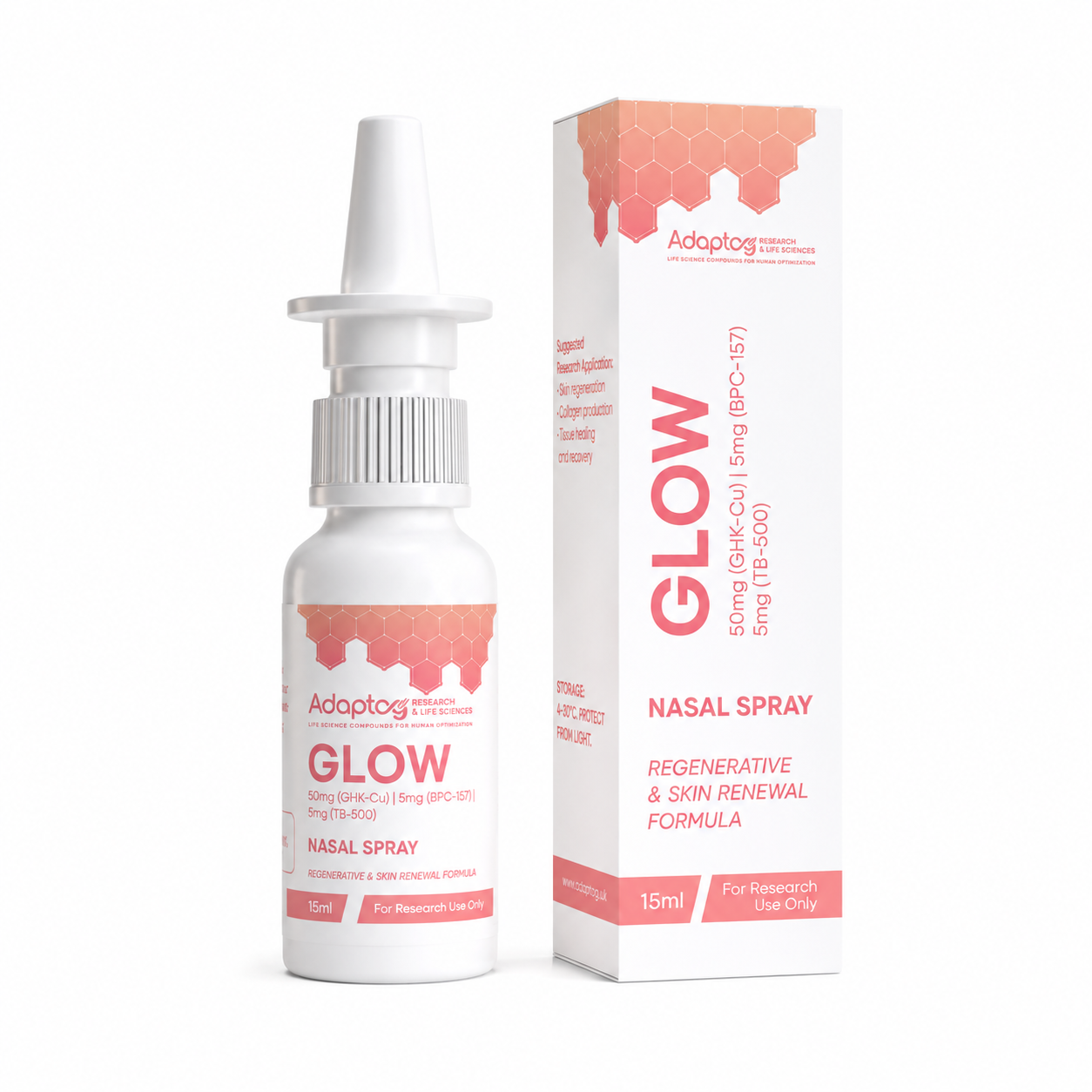
GLOW (50/5/5)

$150.00

GLOW (50/5/5) from Adaptog Peptides is a research-grade blend combining 50mg GHK-Cu, 5mg BPC-157, and 5mg TB-500 in a single vial. This formulation is widely used in studies that examine skin-matrix biology, fibroblast activity, and connective-tissue research. Adaptog supplies GLOW at consistent purity so investigators can run reproducible protocols without preparing three separate reconstitutions.

The GLOW blend brings together three peptides commonly used in regenerative and dermatological research models. GHK-Cu is studied for its copper-binding activity and influence on extracellular matrix markers, while BPC-157 and TB-500 contribute well-documented profiles in cellular migration and repair-pathway research. Adaptog Peptides supplies GLOW (50/5/5) so laboratories can investigate the combined behaviour of these compounds under controlled conditions.
Researchers often buy GLOW (50/5/5) from Adaptog Peptides for projects such as:

Investigating fibroblast and keratinocyte responses in cultured models
Studying collagen and extracellular matrix marker expression
Examining angiogenic and migratory activity in tissue research
Comparing combined-peptide protocols to single-compound controls

Because GLOW pairs three well-characterised peptides at fixed ratios, it suits laboratories looking for efficient, repeatable workflows. Adaptog Peptides delivers GLOW (50/5/5) as a high-purity laboratory reagent prepared exclusively for qualified research environments. It is not intended for clinical, diagnostic, or therapeutic application.
For research use only. Not for human consumption.

Product Description

The GLOW blend brings together three peptides commonly used in regenerative and dermatological research models. GHK-Cu is studied for its copper-binding activity and influence on extracellular matrix markers, while BPC-157 and TB-500 contribute well-documented profiles in cellular migration and repair-pathway research. Adaptog Peptides supplies GLOW (50/5/5) so laboratories can investigate the combined behaviour of these compounds under controlled conditions.
Researchers often buy GLOW (50/5/5) from Adaptog Peptides for projects such as:

Investigating fibroblast and keratinocyte responses in cultured models
Studying collagen and extracellular matrix marker expression
Examining angiogenic and migratory activity in tissue research
Comparing combined-peptide protocols to single-compound controls

Because GLOW pairs three well-characterised peptides at fixed ratios, it suits laboratories looking for efficient, repeatable workflows. Adaptog Peptides delivers GLOW (50/5/5) as a high-purity laboratory reagent prepared exclusively for qualified research environments. It is not intended for clinical, diagnostic, or therapeutic application.
For research use only. Not for human consumption.
Compound Information
MOLECULAR PROFILE
TypeSynthetic compound
CategoryResearch Compound
Purity≥99%
FormLyophilized powder
STORAGE REQUIREMENTS
Lyophilized (powder)

-20°C · 24+ months

Reconstituted

2–8°C · ~30 days

Certificate of Analysis

Third-party tested for purity and quality.

PURITY
0 %
Variant GLP3-RT 10mg
Lot # REF0001
Labeled 20mg
Actual 22.61mg
Tested APR 15, 2026

Coming soon

Research
New England Journal of Medicine

Triple–Hormone-Receptor Agonist GLP-3 (RT) for Obesity — A Phase 2 Trial

2023
DOI: 10.1056/NEJMoa2301972
· Jastreboff AM, et al.

New England Journal of Medicine

Triple–Hormone-Receptor Agonist GLP-3 (RT) for Obesity — A Phase 2 Trial

2023
DOI: 10.1056/NEJMoa2301972
· Jastreboff AM, et al.

New England Journal of Medicine

Triple–Hormone-Receptor Agonist GLP-3 (RT) for Obesity — A Phase 2 Trial

2023
DOI: 10.1056/NEJMoa2301972
· Jastreboff AM, et al.

Related Research

COA Request

Researcher verification.
kelvian Labs sells research peptides exclusively to qualified researchers and laboratories for in vitro and laboratory use. Please confirm before continuing.
By proceeding you affirm the statements above are true. Products are not for human or veterinary use, not for use in diagnostic procedures, and have not been evaluated by the U.S. Food and Drug Administration.

Not a researcher? Exit